Yang Liuxizi’s graduation exhibition “Sedimentary Blue”, representing a condition of fragmentation or healing. This concept stems from two dreams, narrating a drama and two themes: fragmentation and ethnic identity. The author combines personal memories with inspiration from the character Desdemona in Shakespeare’s play “Othello” to craft the entire story. What happened before Desdemona’s murder? These dreams are presented as a seven-act visual piece, illustrating the gradual restoration of individuals with similar experiences from a fragmented state.
In the exhibition hall, there are two upright screens, one positioned in the center of the space and the other on the right side.

The first act begins on the screen to the right, depicting three guards in white robes near stalactite formations of diverse shapes (an exact description from Yang Liuxizi’s vivid dream). Everything originates from a cave, which has always possessed some primal power. The characters in the screen alternately stand and sit, accompanied by occasional abstract paintings appearing on the wall in different colors. After several static segments, each of them selects a sculpture (stalactite) and exits the screen. The screen represents both a cave and the threshold of a dream, where individuals carry artifacts (stalactites) from the cave through the dream threshold and emerge with surprise at the exhibition venue, marking the gradual transition of “Sedimentary Blue” to another scene.
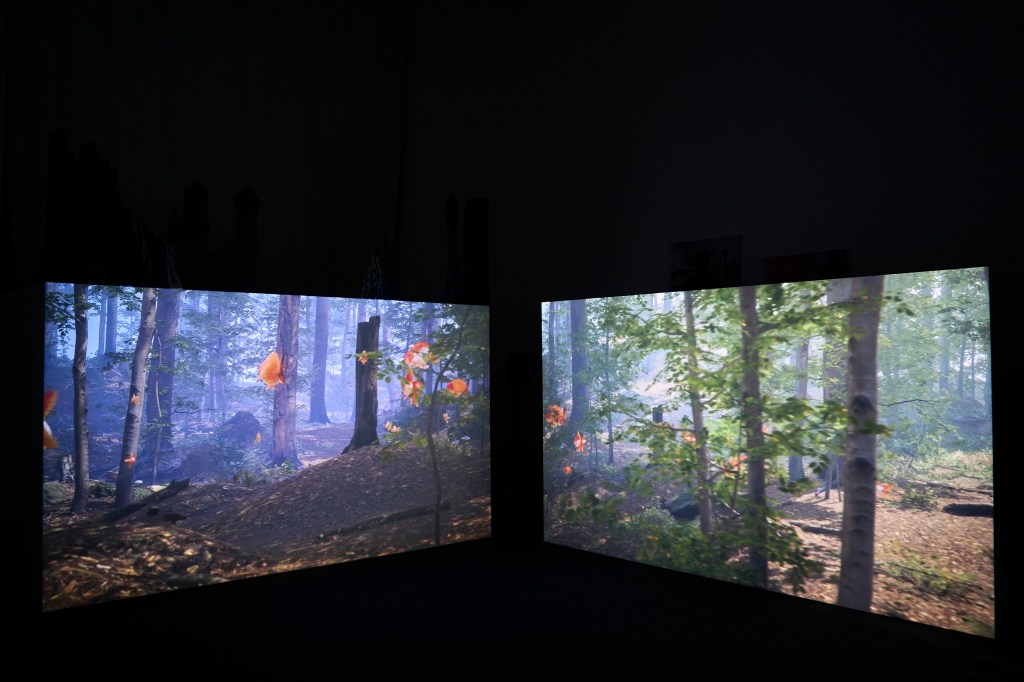
The second act shifts to a forest from a first-person perspective, with sunlight streaming through the gaps in the trees and gentle breezes rustling the leaves. Our view wanders along a path in the woods, and suddenly, some goldfish swim into view from the middle screen, while on the right side, goldfish and the forest are seen from another angle. Accompanied by background sounds and the goldfish, the audience gently enters this dreamlike state.
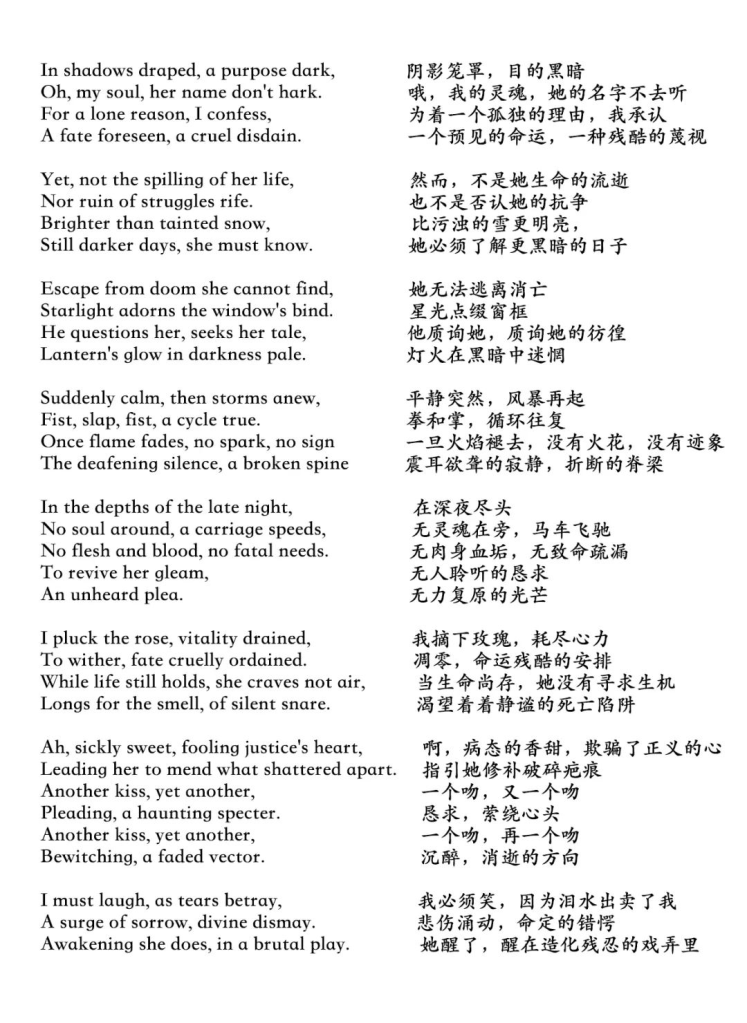
The third act transports the dream to a dilapidated castle resembling a Roman amphitheater, with real castle paintings connected to the scene. Clouds intermittently obscure the moon in the sky, and torches on the castle flicker. As a large circular spotlight above the stage illuminates, actors start performing a Shakespearean-style English poem relay, written by the author and ChatGPT, adapted from Desdemona’s experiences and narrative as a soul over several centuries.
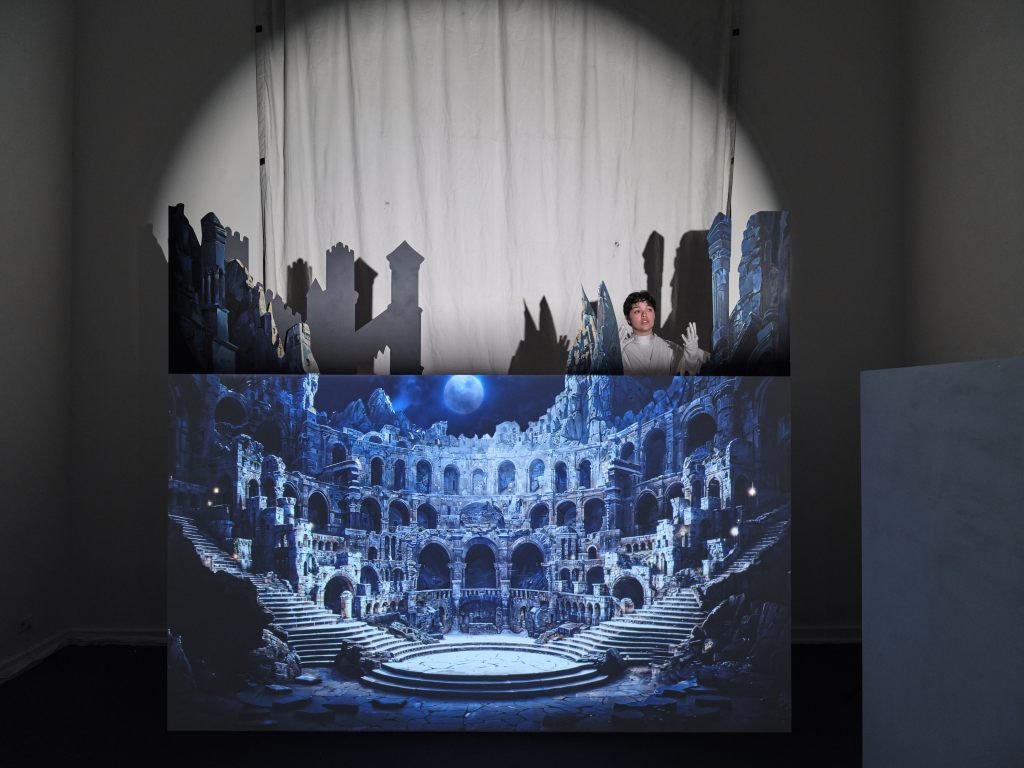
Yang Liuxizi initially felt that the castle design didn’t match her dream’s imagination. Referencing M.C. Escher’s visual illusion techniques, she designed several versions, but the limitations of two-dimensional representations couldn’t adequately convey her ideas. The question of how to retell stories within static images and unfold them over time, has always been the challenge of narrative art. Later, she read about Vincenzo Scamozzi’s 16th-century Palladian-style Olympic Theater in Vicenza, Italy, which used perspective illusion techniques to extend illusory space beyond backdrops and archways, centered around the viewer and expanding in all directions, blending reality with the virtual, creating a moving tableau.
The fourth act shifts to an interview with a ghost wearing a gorilla mask (a tribute to the radical group “Guerrilla Girls” from the 1980s) in a white robe. The robe’s design is inspired by Desdemona’s attire in her bedroom; its stand-up collar features stitched pleats, with overlapping sections widened using the concept of Chinese traditional clothing Hanfu, left piece cover right (Ying above Yang) symbolizing a departed soul. While watching “Othello,” Yang Liuxizi wondered what happened before Desdemona’s death, which seemed sudden but perhaps had gradual indications.
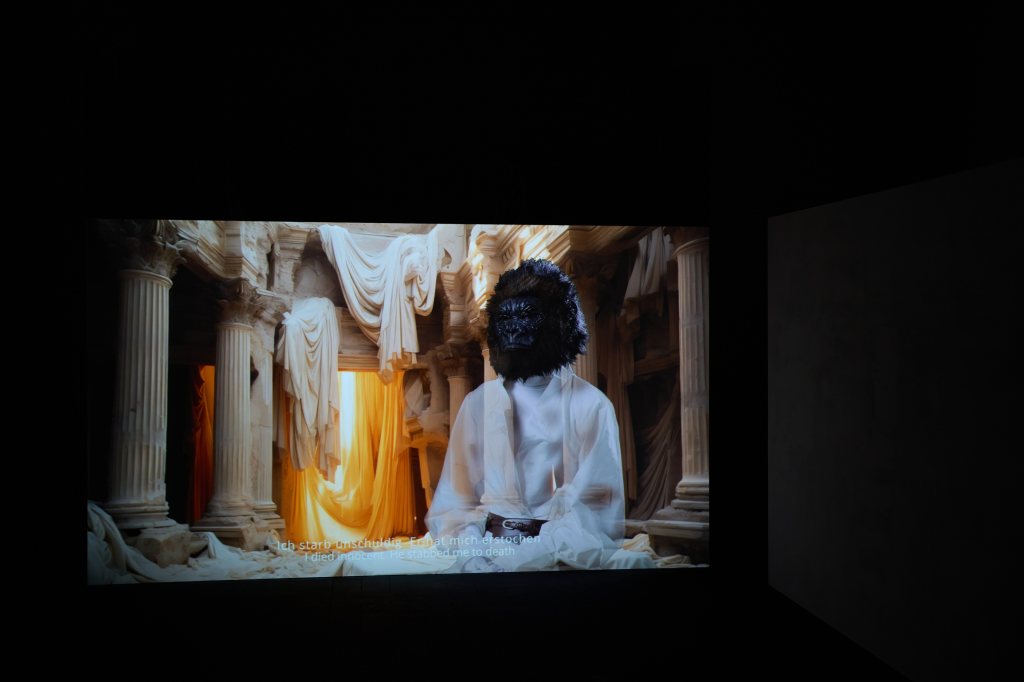
After researching, the author discovered that many women in similar situations couldn’t recognize danger from the start. At the end of the conversation, Desdemona resolves her own questions, wondering why such events occurred, if she did something wrong, and why Othello acted as he did. At the interview’s conclusion, Desdemona expresses understanding for her husband, whose racial identity wasn’t accepted by society. Shakespeare predicted this tragedy over four centuries ago about racial identity. As a foreigner studying abroad, particularly during a pandemic, the author resonates with the causes of Othello’s tragedy: hatred between different races, fear between different genders, and the fear of those who look different or are incomprehensible. This fear is colder than death, consuming their souls.
The fifth act features an ocean with painterly strokes, derived from a small part of the sky in Van Gogh’s painting “Two White Poplars on a Road.” The audience is immersed in a flowing, luminous, blue undulating liquid, bringing about a soothing and healing feeling from the whispers of the swaying sea horizon.
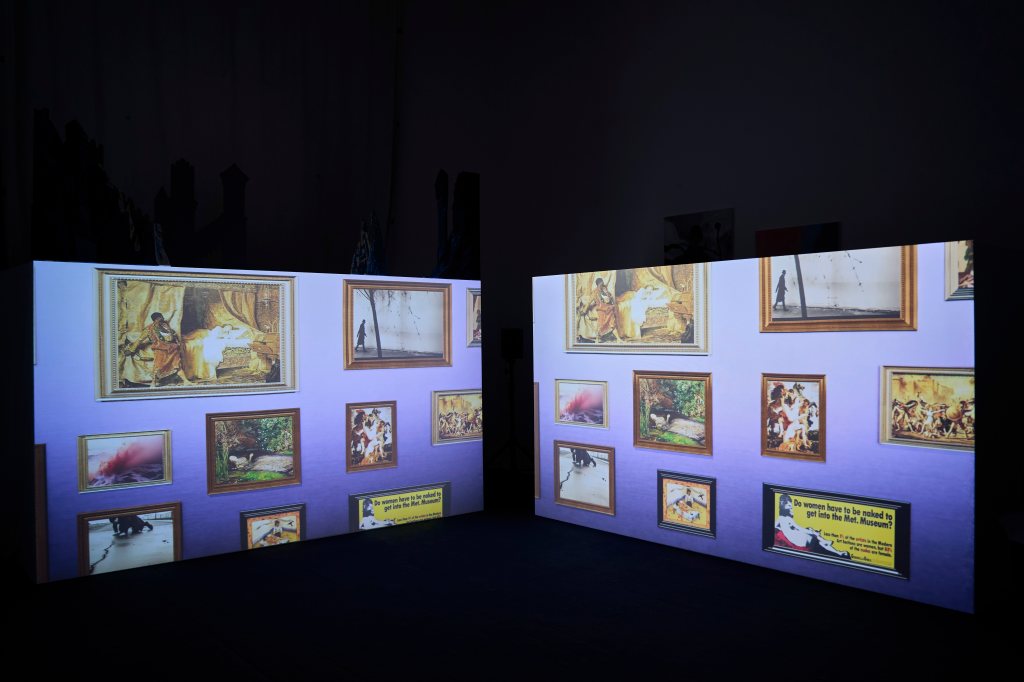
A poetry with the theme of penetrating gazes connects with the museum’s exhibition walls, gradually interspersed with classic oil paintings and photographs made by Midjourney.(based on real photos of bruises) The images include “The Intervention of the Sabine Women” and “Rape of the Daughter of Leucippus.”
The AI-generated photographs couldn’t initially identify the human body images depicting bruises; it recognized contusions as thorns and cracks in the earth because harm and violence weren’t permitted in its perception. The juxtaposition of real oil paintings and fictional photography, the blend of dreams and reality, exemplify Yang Liuxizi’s ongoing creative method. She intertwines reality and virtuality, employing theatrical forms to narrate every part of her dreams.
In the final act’s conclusion, the guards retrieve the sculpture (stalactite), gradually returning it, allowing the author to feel as though she’s being pieced back together from a fragmented state. Like thoughts and rational emotions restored from loss, Jean-Luc Godard once said, “Art is not a reflection of Reality, it is the reality of a reflection.” Yang Liuxizi uses painting, sculpture, costumes, imagery, poetry, and performance to recount the stories she has witnessed, allowing these narratives to guide her life with greater precision.
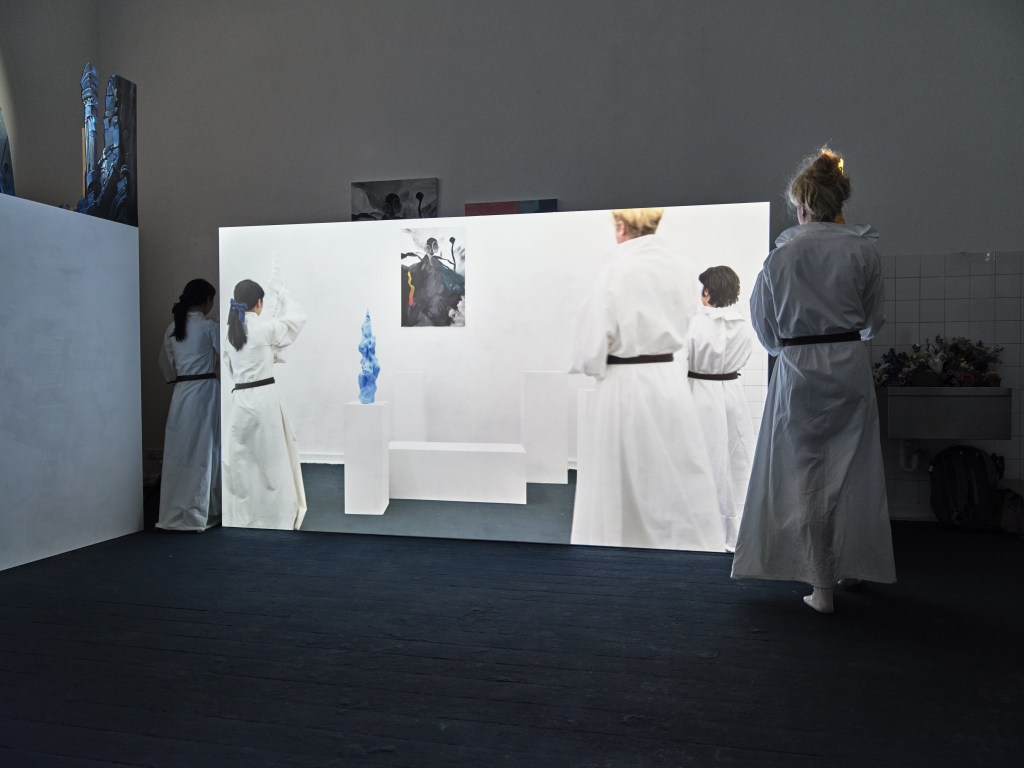
杨柳西子的毕业展《淤青》向观众展示着一种沉积的青色破裂或愈合的状态。它来自于两个梦,讲述着一部戏剧和两个主题: 破碎和族裔身份。作者结合自身记忆和莎士比亚的戏剧《奥赛罗》里女主角苔丝狄蒙娜(Desdemona)的幽灵创作了整个故事。在苔丝狄蒙娜被杀死以前发生了什么?一场悲剧的因果片段,随着作者以梦为载体创作了七幕不同的影像作品,拥有相似困境的人被一点点地从碎片化的状态拼凑出来。展览大厅里是有两个立起来的荧幕,一个位于空间正中央,另一个位于它的右侧。
第一幕右侧荧幕出现,三个穿着白色睡袍的守卫守护在形态各异的贾科梅蒂风格的钟乳石附近(这精确的描述来自于杨柳西子的清晰之梦 ),一切从洞穴里开始的,洞穴古往今来都具有某种原初的力量。屏幕中的主角们时而站,时而坐,墙上时不时会出现一些不同色彩的抽象画,相对静止的片段变换了几次后,她们三人分别挑选了其中一个雕塑(钟乳石)走出了屏幕外,屏幕即是洞穴,又或说是梦的门槛,人们端着洞穴中的艺术品(钟乳石),踏过了梦之门槛,惊喜的出现在展览的现场,至此《淤青》慢慢地隐入了另一幕。

第二幕开始由第一视角进入森林,阳光透过林间的缝隙洒下,微风吹动树叶,我们的视角徘徊在林中的小路,忽然一些金鱼游入进中间荧幕的视线上方,右侧则是从森林另一个角度看到的金鱼和树林。观众伴着背景音和金鱼一起缓缓进入这个梦境。
第三幕,梦境切换到一个罗马斗兽场式的破败的城堡,城堡上方有真实的城堡绘画与画面连接,天空中的乌云让月亮时隐时现,城堡上的烛火忽明忽灭。随着舞台上方巨大的圆形灯光亮起,演员用接力的形式开始表演一首莎士比亚风格的英文诗,诗是由作者跟ChatGPT模仿莎士比亚风格的韵脚写的,诗歌内容根据记忆改编苔丝狄蒙娜生前的经历和作为一个灵魂在这几百年间对自己的叙述和回答。
杨柳西子说最开始设计城堡的时候总觉得不符合梦里的想象。参照莫里茨·科内利斯·埃舍尔(Maurits Cornelis Escher)的视错觉设计了几个版本,但平面的局限性并不能很好地被表现出来。如何在静止的图像中重述故事,如何在时间中展开,是叙事艺术家永恒的挑战。后来她无意中读到:“Vincenzo Scamozzi在16世纪的意大利维琴察建造的帕拉迪奥式奥林匹克剧场,利用透 视错觉天顶画(Quadratura)——错觉建筑的技术,将错觉空间超出背景幕布和拱形台口,以观看者为中心,向各个方向延伸,虚实交错。”于是她向midjourney描述了想要的画面,做出了许多次调整后终于得出了想要的场景。不管是月光让整个场地时不时被照亮,还是midjourney生成的具有纵深感的布景,都让整个“梦境”更像带有光照效果,成为了会移动的图画。
第四幕场景切换到一个戴着猩猩头套(致敬20世纪80年代的激进团体“游击队女孩”),身着白色睡袍的幽灵正在接受采访。睡袍是她根据苔丝在卧室里的穿着设计,睡袍的立领做了缝合褶皱,重叠的部分做了加宽处理,使用汉服左衽的概念,左阳右阴,隐喻着这是位死去的灵魂 。杨柳西子看《奥赛罗》的时候在想,苔丝死之前发生了什么,这个死亡有些突然,也许是循序渐进的,也许早就有预兆。
作者深入探寻后发现,很多同样处在困境的女性都有相似的经历,无法从一开始就识别危险。谈话的最后,苔丝也和自己的问题和解了,她可能会想为什么会发生这样的事情,是不是她做错了什么,奥赛罗为什么会这样做。访谈的结尾,苔丝说到她理解了丈夫,因为他的种族身份不被这个社会接受。莎士比亚在四百多年前就预言了因种族身份造成的悲剧。作为一个外国人在异国求学,尤其是瘟疫大流行期间,创作者也对奥赛罗悲剧的成因感同身受,不同种族互相憎恶,不同性别互相害怕,人们害怕和自己长得不一样的人,害怕自己无法理解的人。这种恐惧比死亡更冷,恐惧吞噬了他们的灵魂。

第五幕画面显示出具有油画笔触的海,这片海出自于梵高的绘画《山间小路上的两棵白杨树》里的天空的一小部分,观众被置身于一种流动的,发光的,蓝色摇曳的液体之上,人的心情得到舒缓与疗愈,一种来自于摇晃着的海平线的低语。
具有凝视目光的诗歌在后半部分连接了博物馆展墙上,画面渐渐地出现油画和摄影作品。画面中有《劫夺留西帕斯的女儿》有《萨宾妇女出面调停》等
摄影作品都是AI根据真实的淤青生成的图像,AI一开始并不能识别这是人类身体上出现的图像,它将淤青识别成荆棘和大地的裂痕,因为对它来说伤害和暴力是不被允许的。真实油画和虚构摄影的穿插,梦境和现实的结合,是杨柳西子一直以来的创作方法。她将现实性与虚拟性这两级杂糅在一起,利用戏剧的形式分解每一部分的梦。

最后一幕梦的结尾,是守卫们将拿走的雕塑(钟乳石)再拿回去,在慢慢拿回去的过程里,作者本人感觉自己就好像从碎片的状态,又被一点点重新拼接了起来。就像被夺去的思想,理智的情感都渐渐地被找回来了。 让·吕克·戈达尔说:“艺术家不是像他的生活那样创作,而是像他的创作那样生活。”杨柳西子利用绘画、雕塑、服装、影像、诗歌和行为来讲述她曾看到的故事。并且这些故事能让她更确切地生活。
Photo: Kai Werner Schmidt
Ying-Tzu Chen
 1001 nights from Irina's dream