In October, 2021, I launched an auction under the cooperation with Goethe Institute Milan. The institute raised three questions in response to the memorial of Beuys and the concept of Art: What is the relationship between art and society? How to validate the value of art? How to embody artists’ own style?
This work originated from a dream I had four years ago. I dreamed of a crowd of audience, waiting in a white, spacious hall. Soon, I entered the hall with a bunch of artists and created a painting according to orders. Once it was completed, the painting was auctioned. Instead of being sold as a whole, the highest bidder of each part received his/her piece, like a cake being sliced and shared.
The artists who painted in the auction had been asked a question a week before the event: If it would be your last time to paint freely in your lives, what would you paint? I did not ask for their answers, nor did I need to. I looked forward to their contemplation: why to paint, how to paint, what to paint. Other than ordinary auctions, the bidders witnessed the whole process of the work from scratch.
The artists followed orders during the creation. We were like instruments. Although we all made different ‘sounds’, we played in harmony under the instructions of the ‘music score’. There was a chart on the screen showing the exchange rate of Euro to different currencies.
There were plenty of unexpected incidents during the auction. Someone kept pushing and started a price war; someone hesitated; someone was stunned; someone was flattered and someone regretted. The auctioneer had to respond fast to any circumstances, like determining the movement to hammer the price, maintaining the atmosphere and alerting for the bidder paddles. This exciting commercial activity fascinated me by showcasing various yet overlapping identities shared by the participants. They improvised and naturally became artists shining in this performance. The ghost of capitalism, who steers the art market and sometimes screws it up, was the only absentee that day.
2021年10月,我与米兰歌德学院合作策划了一场拍卖会,歌德学院就纪念博伊斯和艺术构想提出三个问题,即如何看待艺术与社会的关系?如何确定艺术价值的有效性?以及如何在作品中体现自己的艺术风格?
作品实际上来自于四年前的梦境,我梦见观众在空旷的白色大厅前等待着什么,不一会,我和艺术家们入场,在观众面前,创作一幅听指令行动的画,完成后立即拍卖,作品不可以拍卖一整幅,只能像买切糕一样买其中一部分,每一部分的最佳出价者,会得到当场切割下来的绘画。
在拍卖会上参与绘画的艺术家们在行动一周前被问及一个问题,假如这是人生中最后一次能随心所欲的绘画,你们会画什么?我没有询问答案,也不需要他们告知答案。我希望他们思考,为什么要画画,要画什么,怎么画。有别于传统拍卖会,竞价者们亲眼目睹了艺术拍品从无到有的过程。
过程中是听指令行动的,我们就像乐器,尽管每个人发出的声音不同,但在“乐谱”的指令下才和谐的演奏。大屏幕里是预估价欧元和不同币种的对照。拍卖会上发生了很多意想不到的事情,有人突然加价;两个竞拍者开始拉锯战;有人犹豫,有人惊讶,有人洋洋得意,有人追悔莫及。拍卖师需要迅速判断是否还有人出价,是否可以落槌,什么时候要让气氛愉快,什么时候要提高警惕。这一切都来自于这个紧张刺激的艺术商业活动,我体验到了多重身份的欢愉,观众也饶有兴致的举牌叫价,艺术家们即兴发挥的让人眼前一亮。驱动艺术市场天使亦或魔鬼的资本成为了这场行为艺术唯一的缺席者。

Art is not a pie in the sky. Art activities are never separated from our society, as they would become meaningless without our participation. As artwork are evaluated in auctions, it reminded me of a dream I had, which has also been a source of inspiration in my art creation.
What does an ‘Art Auction’ sound to you? Privilege? or welcome-to-all? Participants of ordinary auctions somehow seek for recognition of their identity. However, in this auction, every single one of us participated and enjoyed art. Starting from the beginning of this auction, everyone became artists.
I had a dream four years ago. I was in a completely sealed art museum called ‘White Cube’. It was packed with people who were socializing with each other. Those people were so confused, having no clues why they were holding numbered plates.
Then came a bunch of artists, and I was one of them. All of us dressed in pale-white, coverall, protective suits. We were so heavily masked that no one could glimpse their faces. Despite our uniform clothing, each of us held distinctive paints and tools. We waited silently in front of a huge canvas. Soon I gave a command, and we started painting collectively.
Around 30 minutes later, we completed our creation and exited the hall. I left the team and took off my protective suit. Underneath the suit I dressed formally. Then I took out a gavel, stood behind a lectern and started an auction of the painting which we had just finished. Anyone was welcomed to participate in the auction. However, bidders were confined to bidding for only a part of it, instead of the whole painting. But still, there were bidding frenzies. The winning bidders cut out the parts they won on site and took the parts away.
Based on this inspiring dream, I gave this performance to express my view on art. Although art is so closely linked with our society, nowadays only two commercial events would grab the public attention: the stock market and auctions (such as the Christie’s and Sotheby’s). Auctions, especially the night auctions, symbolized one’s social status. For the general public, auctions mean mysteries and privileges.
The identity is a crucial drive for someone to participate in an auction. Here is a quote from the book – The $12 Million Stuffed Shark The Curious Economics of Contemporary Art. ‘A person’s buying behavior is influenced by group identity. A buyer may wish to join a group of art collectors or hope to become a member of a museum board by donating an important work of art. A hedge fund manager hopes that art will make him a culturally literate tycoon in financial circles, and a foreign buyer may want to assert his status through a sought-after work.’
Identity, as a process of self-awareness, is a key factor in both micro and macro level. On a micro level, behaviors and life choices in various stages are heavily influenced by how the actor perceives his/her identity at different time phrases. Identity helps individuals locate their social positions and establish self-esteem. On a macro level, group members having the same collective identity share a sense of ‘we-ness’. It promotes internal cohesion and keeps members in solidarity, hence smoothens interactions in our society and paves the way for our civilization.
A piece of artwork may be the beacon in our search for identity. An artist expresses her or his observations of the society through her or his work; reciprocally, the society rewards the artist with what values.
There were many surprises in the auction. Someone broke the ascending-bid pattern by rocketing the bidding price; someone often got involved in tug-of-war games with other bidders; some kept hesitating; some got overwhelmed; some got satisfied and some got disappointed… I had to give rapid responses, judging whether the bids were still open or knocked down. I also needed to take care of the atmosphere and adjust the tempo of the auction. All these human comedies were condensed in a single activity: the auction. The participants, who were excited or confused; and the witnesses, who focused on the gossips, are all involved in it. Just like how the auctions attracted everyone’s eyeballs nowadays, like how Banksy destroyed his artwork and the NFT market became well-known.
In auctions, the billion and trillion price tags on one hand stimulate the bidders, on the other hand stunned the by-standers as they revealed the so-called ‘exact value’ of the artwork. Are we really able to quantify a price for art? Million souls have millions of distinctive ways to perceive the world.
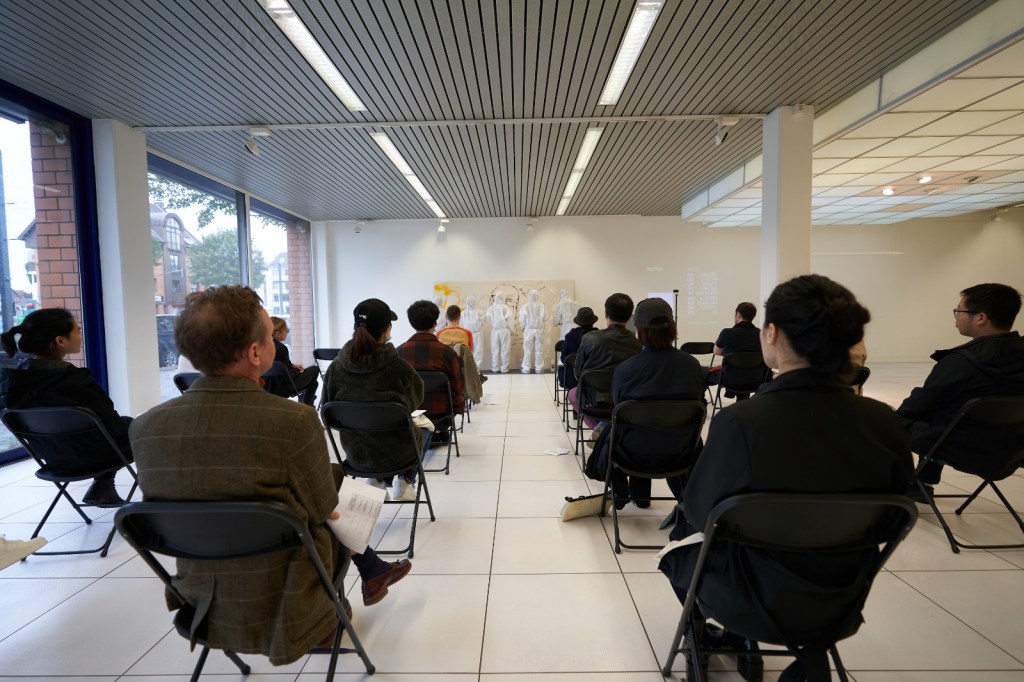
Auctions, as a way of pricing and determining the ownership of artwork, are launched partly due to the incapability of conventional methods in measuring values of pioneer work, such as contemporary artwork. When bidders are crowded in an auction hall, the valuation of an artwork becomes a collective behavior stimulated by competitions and vanity of all bidders. In that sense, auctions might be one of the most efficient and direct ways to evaluate an artwork nowadays.
A ‘traditional’ auction simplifies the value and meaning of an artwork into digits. What I have planned in this project is to allow the nature of an artwork – participation and sharing with the public – to play an essential role in the auction. What if Picasso is sitting in the auction hall, witnessing his work being knocked down? What if a Composition of Mondrian is being cut into colorful squares and brought back to dozens houses after the auction? How will the bidders react? Would they be more emotionally involved with the artist and the artwork? Would they share a sense of ‘We-ness’, a sense of ‘art people’?
I asked the artists in my auction: ‘If it is your last chance in your life to draw in your own will, what would you draw?’ I did not need an answer, and I did not want to know their answers. I only needed them to contemplate their deepest desire for creation.
Therefore, I stressed the value of this painting to the bidders before the auction. This artwork is the distillation of the artists’ souls, the fruit of their life and the one-and-only piece in this world. This painting is a symphony, carrying the unique sounds from every one of the artists. I differentiated my auction from the normal ones. I wanted it to be relaxing, enjoyable, barrier-free and open-to-all. I want everyone to be able to take part in this ‘privileged’ activity and take artwork home. Just like what the video illustrates: everyone takes part in the world of art.
(Special thanks to Xiaolei Wang and Sze Yeung Lau.)
Liuxizi Yang (Irina)
Düsseldorf
07/10/2021
 1001 nights from Irina's dream